

How to grow an Airbnb business with financing
Making your Airbnb business successful doesn’t just happen overnight. It takes time, dedication, and a good understanding of hospitality. But once you’ve purchased your property (or converted your existing one), started taking customer bookings on Airbnb, collected positive reviews, and made your operation as efficient as possible, what’s next?
Maybe you want to buy a property for Airbnb, renovate a second Airbnb property, or upgrade your current offering to increase your nightly rate? Whatever your plans, you might not want to risk your cash reserves to fund all these changes. And that’s exactly what finance is there for.
Keep reading to learn how to finance your next step.
Key Takeaways
- To scale, you need upfront capital. To expand your portfolio, you need to cover security deposits, furniture, refurbishments, and manage overheads all before a paying customer steps through your door.
- Lenders do consider short-term lets as commercial businesses. As long as you can evidence consistent occupancy rates and a stable trading history, most UK alternative lenders will accept your loan application.
- Hidden costs can disrupt cash flow. Unexpected expenses can include regulatory licensing fees, specialist insurance, maybe your utility bill increases without warning, or you have to survive through seasonal voids. All these costs must be considered in your expansion budget.
- There are flexible funding options. Plenty of loan options are available for your Airbnb investment, from unsecured business loans to merchant cash advances and more. You can find funding to match your business needs.
The real cost of expanding and running an Airbnb
It’s not just the acquiring of a new property that costs money; it’s investing in more formalised systems to manage several listings at once or outsourcing support like cleaning or marketing.
To plan your budget accurately, it’s a good idea to separate your costs into three sections: upfront expansion costs, ongoing operational expenses, and hidden costs.
Upfront expansion costs
These are the high costs you can’t overlook for your Airbnb investment property.
Refurbishments, interior design, and security setup. To charge a high nightly rate, you need to meet customer expectations; that means investing in quality interiors like furniture and appliances, going above and beyond with extras like outdoor seating, firepits, or hot tubs, and ensuring all your properties consistently meet the highest standard.
How customers access your property and your security setup are also essential upfront costs. To manage guest access across all your properties, you’ll likely invest in smart keyless locks, and to keep guests and property safe, things like exterior security cameras or noise monitoring sensors.
Ongoing operational expenses
These are the costs that can easily become overlooked, but together, they add up to significant expenditure.
Cleaning and turnover staff costs are an essential expenditure. Unless you have only one or two properties in close proximity and you can dedicate your own time to managing this yourself, you’ll need to consider a third-party turnover company to maintain the high cleanliness standards guests will come to expect.
Virtual assistants and managing staff. Outsourcing review management and customer messaging to a virtual assistant can trim a lot of the time-consuming admin. And finding and retaining reliable management staff is essential for fixing small day-to-day problems like leaking sinks or electricity outages.
Software investment. As you scale, you could benefit from property management systems to help you manage bookings more effectively. Eventually, you might want to commission a direct booking website so you can skip third-party platform commissions altogether.
Hidden costs
Some areas of the UK, like Scotland, require all hosts to have a short-term let license. And if you’re based in Greater London and you want to host for more than 90 nights inside a calendar year, you need to apply for planning permission. It’s important to understand these hidden costs when planning your next buy-to-let Airbnb location.

Can short-term let operators access business finance?
Yes, short-term let operators can absolutely access business finance. Commercial lenders will view your Airbnb business as a legitimate accommodation and hospitality business. These lenders look at the entire business picture: they look at your cash flow, revenue consistency, trading history, and booking volume to make their lending decisions.
You don’t have to be a large limited company to access finance, so if you’re a sole trader or an LLP, you can still apply for business finance.
Business loan options for Airbnb businesses
Whichever loan is right for you depends on how quickly you need working capital, your reason for the loan, and your circumstances.
1. Unsecured business loans
If you’re looking to access finance quickly to buy furniture, redecorate, or fund marketing campaigns, then an unsecured business loan is worth considering. Through our lenders, you can apply for up to £500,000 without having to risk your assets. Lenders make their lending decisions based on trading history, credit profile, and business cash flow.
2. Merchant cash advance
As a business taking card payments from your Airbnb guests, you might be eligible for a merchant cash advance (MCA). An MCA is where a lender advances you a sum of money, and you automatically repay it as a fixed percentage of your daily or weekly card sales.
These finance solutions are particularly useful for businesses in hospitality who typically see seasonal trends. Because you repay a percentage, if you take fewer bookings, you repay less, taking away financial stress that can come with fixed payments.
3. Secured business loans
If you want to borrow a higher loan amount or reduce the interest rate, you might consider a secured business loan. You can apply for in excess of £2 million with this loan, which is better suited to those with a high-value asset they’re willing to risk to secure the loan, and business owners looking to fund significant property renovations or purchase properties.
4. Asset finance
You can use asset finance to purchase high-value assets like hot tubs or high-end kitchen appliances. Asset finance helps you acquire these top-end items without severely depleting your working capital. Instead, you repay the finance in affordable monthly instalments.
5. Revolving credit facilities
With revolving credit, the lender approves a credit limit, and you can draw this down as and when you need it. Dipping in and out of cash like this gives you the ultimate flexibility when lending money. And you only pay interest on the funds you draw down, too. A revolving credit facility gives you the perfect financial safety net, knowing it’s there if things go wrong, or in case you want to take a calculated risk without using your own funds.
What lenders look for when you apply
Lenders want to see you can comfortably afford to repay their money; that’s all they typically care about.
So, they’ll want:
- bank statements, etc.)
- a trading history of at least four months
- good personal and business credit scores (you can still apply for a loan with bad credit)
- a comprehensive business plan
How can Capalona help?
You’re busy running your business, so finding and comparing eligible loans and lenders shouldn’t drain what little time you have.
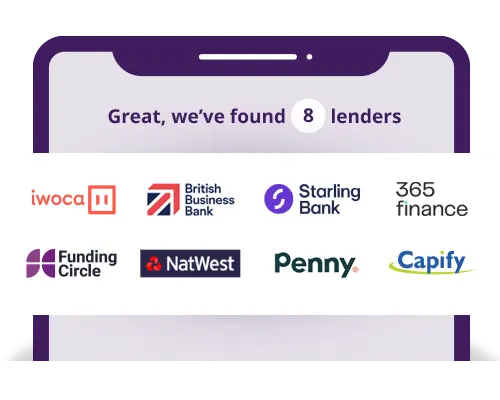
At Capalona, our free business loan comparison tool makes finding funding quick and easy.
- We match you with eligible lenders in minutes
- We only conduct a soft credit check, so there’s no impact on your credit score
- And we work with a panel of UK alternative lenders offering tailored solutions







 FAQs
FAQs 0330 223 5036